Page Views for this Blog

Showing posts with label Humboldt High School. Show all posts

Wednesday, August 14, 2019

2019-2020 School Year Overview By-Grade for Classroom 2403 (Mr. Allen)


All of us are looking forward to having he greatest Academic Year at Humboldt High School. 

Here are the teachers that will be in classroom #2403 for English 12 and 10 (AP English Literature/Composition, EL-12, ELA-10, and EL 10 (2019-2020):

Don Allen, M.A.Ed./MAT
donald.allen@stpaul.k12.mn.us 
Classroom Direct: (651) 744-5415
AP Literature/Composition Grade 12
Unit 1 - Short Fiction I
Unit 2 - Poetry 
Unit 3 - Longer Fiction I or Drama: Special Topics - Horror 1963-2019 (Allen, 2019)
Unit 4 - Short Fiction II
Unit 5 - Poetry II
Unit 6 - Longer Fiction or Drama II: Special Topics: Masculinity and Femininity in the Marvel and DC Comic Universe (Allen, 2019)  
Unit 7 - Short Fiction III
Unit 8 - Poetry III - Who was author/activist Toni Morrison and Why should you read her poetry? (Allen, 2019) #deep_dive
Unit 9 - Longer Fiction or Drama III - Special Topics: Comparing and Contrasting Occam's Broom to The Picture of Dorian Gray (book & online) by Oscar Wilde


Mr. Michael Paradise - EL Teacher 
Quarter 1: Explanations of Personal Narratives, Textual Analysis, Author’s Voice, and Literary Synthesis Essay (Introduction of One-Year Research Capstone Chapter 1 - Introduction and Research Question) 
Focus: Reading, Writing, Formatting
Quarter 2: Explanations of Argumentation, Critical Lenses and Rhetoric for the Future - Civil Discernment 101 (Research Capstone Chapter 2 - Literature Review) 
Quarter 3: Explanations of Special Topics: Textual Analysis, Philosophy, and Critical Thinking (Research Capstone Chapter 3 Methods and Chapter 4 Results)
Quarter 4: Explanations of College Ready Senior Seminar: Senior Research Project Creating A Journal Article,
Abstract and Beyond! (Research Capstone Chapter 5 - Results-Final) 

Mr. Moise Fernandez - EL Teacher
Coursework Focus Grade 10 (ELA/EL)*
Quarter 1 Unit: Perspective and Point of View 
  • Literary Analysis (added - What is Plagiarism, and does in have Cultural Differences?)
  • Author’s Decisions Analysis
  • Narrative Writing
Quarter 2 Unit Overview: Why do All Lives Matter? (Activism- per SPPS)
  • Informational Citation: One Text 
  • Annotated Bibliography
  • Multiple Texts
  • Presentation and Discussion


Quarter 3 Unit Overview: Our Beliefs
  • Multiple Text Type Analysis
  • Informative Writing
  • Synthesis Writing
Quarter 4 Unit Overview: Justice and Restitution (What are Reparations ?)
  • Argument Annotation
  • Argumentative Essay
  • Short Speech/Feedback
*All grades will also take part in a Book Clubs with a goal of reading one (1) book per week starting October 1, 2019 (AP Lit/Comp excluded).


Tuesday, July 2, 2019

Invisible Man (Ellison, 1955) Notes and Breakdown (Analysis)

Invisible Man (Ellison) 1955
The narrator changes so drastically from his younger, naive self to his older, disillusioned self, that he can almost be seen as two characters: the narrator who opens and closes the story and the young man who experiences life in the story. As a young black man, the narrator had great hope. He could even forgive the white leaders of the town for shaming him when he realized that they also gave him a new opportunity - to go to the Negro college. During college he sought his own identity, away from his Southern home and his family’s backward way of thinking. Unfortunately, a white benefactor of the college was his undoing. When Mr. Norton asked the narrator to take him to the black community, the narrator obliged, by taking him to see Mr. Trueblood. Mr. Norton was so shocked and upset by Trueblood’s story of incest the he felt physically ill and asked the narrator to get him a drink of whiskey. Fearful about Norton’s condition, the narrator drove him to the closest place that served alcohol; it was a black dive, ironically called the Golden Day. Since a group of black men from the local mental institution were in the bar, things got quickly out of hand, and Norton passed out under the stairs. As a result of these incidents, the narrator was kicked out of school by Dr. Bledsoe, who told the narrator that a black man must never show a white man what he wants to see, only what he should see. It is the first step of the narrator’s process of disillusionment.
The narrator next went to seek his fortune in New York, armed with supposed letters of recommendation from Dr. Bledsoe. He soon learned that Bledsoe betrayed him, and the letters warned against the narrator, preventing him from finding employment. It is a second lesson in disillusionment. Out of work and lost, the narrator was easily attracted to joining the Brotherhood, who offered him a salary of sixty dollars a week to give speeches to excite the blacks in Harlem. The narrator accepted the offer with blindfolds on, fully trusting the promises of the Brotherhood. Much of the novel deals with his finding out the truth about the organization - that they used him for their own purposes and encouraged him to incite the blacks to a riotous level so they would kill one another. Caught in the riot himself, the narrator barely escaped from his enemies, especially from Ras, the Nationalist. He fell into a manhole, where he stayed for a period of time, coming to grips with his own blindness to reality and deciding what to do with his invisibility.

It is crucial to remember that the narrator’s tale is one of gradual disillusionment that is told from the point of view of a black man who has almost totally withdrawn from the social world. He is interested in telling the story of his life in order to come to grips with who he is and to communicate the lessons he has learned through living. In the epilogue that follows the end of the actual novel, the narrator states that he is ready to put his new philosophy of the multiplicity of life into practice; he is ready to emerge from his long period of writing and hibernation. There is a spark of hope that he will be able to successfully handle his future life because he has fully analyzed and discarded his past. 

PLOT STRUCTURE ANALYSIS

Ellison plots Invisible Man along the lines of an allegory, a literary style that presents an abstract meaning thorough concrete or material forms, usually for the purpose of teaching a lesson. In other words, it is a figurative treatment of a subject. It is an ancient form of writing, which is fairly rare in modern writing. In the novel, all the characters and incidents have a symbolic meaning in addition to their own figurative existence and occurrence. The plot depends upon a layering of symbol upon symbol. In fact, Ellison has described the novel’s structure as that of a jazz composition. It has a central theme with harmonic variations made upon it.
The central theme that unifies the novel is the narrator’s search for identity. Initially, the young black man tries to understand his grandfather, who lived like an Uncle Tom on the surface while believing in his mind that he was a resistance fighter who battles the white establishment by agreeing with them. Throughout the novel, the narrator recalls the philosophy of his grandfather and the words he spoke on his deathbed. For a while, the narrator even tries to live out the philosophy of working within corrupt systems and agreeing to their standards in order to get what he needs. In the end, he realizes that his grandfather’s philosophy does not work in modern times.
Another important symbol of the novel, which is repeated allegorically over and over and which refers the narrator’s search for his identity is the symbol of the veil and blindness. The statue at the school, which represents a blindfold being removed or placed firmly on the eyes of a slave figure, is echoed many times in the novel and refers to the narrator's sense of losing illusions and falling back into them. Closely related to the theme of blindness is the central symbol of invisibility. Throughout the story, the narrator tries to deal with being an invisible man, a person that the white man can simply ignore. Besides the narrator, there are many other invisible characters in the book, including the grandfather, Dr. Bledsoe, and Reverend Rinehart. By the end of the book, the narrator has learned to use his invisibility to his advantage.
The novel is also plotted on the principle of ascension and submersion. The narrator begins with the idea that he can ascend from his lowly position in society by the American Dream of hard work and perseverance. Time after time he is pushed back down, submersed because of his color. As a result, he is symbolically often found in basements and finally ends up in a man-hole; he hides underground for awhile, hibernating in order to withdraw into himself, to find meaning in his invisibility, and to come up with his true identity. The novel ends on a promise of ascension, as the narrator states he is ready to come out of hibernation and face a life of multiplicity.
Structurally, the novel is developed in classical form. The epilogue serves as an introduction where the protagonist, the narrator, is presented and the problem, racism, is identified. Most of the story is comprised of rising action, where the narrator has one frightening experience after another; each teaches him about life and helps to remove some of his blindness to reality. Gradually, he begins to come to grips with his own identity in a racist world and accepts the fact that the Brotherhood has used him and his blackness, like so many other white organizations have done. When he is caught up in the Harlem riots, the racism almost kills him, as he is being sought by Ras and other enemies. Fortunately for him, the narrator falls into a manhole, which offers him protection in the total darkness of an underground world. In this “blind” environment, the climax occurs, for the narrator finally puts his life into perspective and sees his invisibility and his identity in a new light. The true moment of climax occurs when he burns the tokens of his past, which he has carried in his briefcase; once freed from this “excess baggage,” he can think clearly about his true self and his future. The falling action centers on his coming to grips with a philosophy of the multiplicity of life, which is not all black or all white, all good or all bad, all weak or all strong, all agreeable or all disagreeable. The narrator also accepts that he has all of these things within himself. The epilogue then serves as the final conclusion to the plot, revealing why the narrator has written the book and explaining that he is ready to emerge from underground and live life as a changed and more hopeful man. 
THEMES - THEME ANALYSIS 
Ralph Ellison's Invisible Man brilliantly brings together the themes of identity and responsibility; in the process he tackles some of the hardest questions about racism in the United States through the long-honored tradition of skepticism and unflinching rationality. Ellison moves his protagonist narrator from the illusion that he can make it as an individual by dedicated hard work to the realization that he must consider the plight of his entire ethnic group as an oppressed people. This realization brings his own liberation.
Ellison's narrator, a Southern black, at first accepts all the assumptions of Booker T. Washington, but with a strong suspicion that in following Washington's policy of ameliorating racism, he is being untrue to his identity. When the narrator gives his address to the drunken and racist white town leaders, he often quotes Booker T. Washington's Atlanta Exposition Address verbatim. He has clearly taken up a formula, with which his own ideas do not fully coincide, on the assumption that it will win him success in a white man's world. When he mistakenly says "social equality" instead of "social responsibility," his own ideas are leaking out, instead of those of Washington. This slip of the tongue becomes immensely important to the ideas of the novel, because it is only in the exercise of social responsibility that social equality can be attained. It is also important because it epitomizes the struggle the narrator will constantly face.


STUDY QUESTIONS - BOOK REPORT IDEAS 

1. Trace the metaphors of blindness in the novel, explaining both the plot significance and the thematic significance of them. 
2. Who in the novel repeats the Grandfather’s philosophy as it was told to the narrator in his childhood? When does the narrator begin to espouse this view himself? 
3. Explore the significance of the tokens the narrator collects throughout the novel (the diploma, the Brotherhood membership, the anonymous letter, the broken bank, and the paper doll puppet). Trace the growth of the narrator using these mementos. 
4. When does the narrator begin to see the weaknesses of the Brotherhood, and why?

5. Compare and contrast Tod Clifton and the narrator.

6. Contrast the narrator in the Prologue and Epilogue to the narrator in the body of the novel. Use specific details and examples of how the two characters differ. 
7. Investigate the ideas of Booker T. Washington as used by Ellison in the novel. How do they influence the narrator?

8. What people and institutions embody racism in its various forms in the novel?

9. Is the mood at the end of the novel hopeful or defeated? Explain your answer.

10. Relate the meaning of the title to the entire novel.

Wednesday, June 12, 2019

Welcome to AP Literature 2019-2020!

Critical Studies author bell hooks (photo: Google search-fair use)
Note: On occasion, I might post a paper about an author that I've done a piece about their theories. This is one occasion.) ReadCritiquing bell hooks Postmodern Blackness: Does Black Literature need the critical apparatus of Black Postmodernism? 

Designated for motivated students with a command of standard English, an interest in exploring and analyzing challenging classical and contemporary literature, and a desire to analyze and interpret dominant literary genres and themes, it is often offered to high school seniors and the other AP English course, AP English Language and Composition, to juniors. The College Board does not restrict courses by grade. Students learn and apply methods of literary analysis and write with a variety of purposes to increase precision in expression. Students in AP English Literature and Composition typically sit for the national AP examination administered each May for the College Board by the Educational Testing Service. The College Board publishes changing information about all AP courses and examinations on its web site.
On one of the three essays students write as part of the examination, students choose a work of literature they will write about. Readers of the exam who get an essay on a work they have not read typically pass the essay to a reader who has. The scoring guides that readers use to rate the essays are developed by experienced readers on site just before the reading begins each June, using some of the actual exam essays. Since those scoring guides do not exist before the Reading, instructors cannot teach to them but focus instead on encouraging text-based analysis.
The College Board publishes a recommended reading list, while emphasizing that it "does not mandate any particular authors or reading list." The reading list contains four major categories:
All categories also incorporate works from traditionally under-represented writers, especially from racial minorities.

The 8 Multiple-Choice Question Types on the AP Literature Exam

If you're planning to take the AP English Literature and Composition exam, you'll need to get familiar with what to expect from the test. Whether the 2020 test date  is near or far, I’m here to help you get serious about preparing for the exam. In this guide I’ll go over the test's format and question types, how it's graded, best practices for preparation, and test day tips. You’ll be on your way to AP English Lit success in no time! Mr. Allen. 

AP English Literature: Exam Format and Question Types


The AP Literature Exam is a three-hour exam that contains two sections. First is an hour-long, 55-question multiple choice section, and then a two hour, three question free-response section. The exam tests your ability to analyze works and excerpts of literature and also cogently communicate that analysis in essay form. Read on for a breakdown of the two different sections and their question types.

Multiple Choice Section

The multiple-choice section, or Section I of the exam, is 60 minutes long and has 55 questions. You can expect to see 4-5 excerpts of prose and poetry. You will, in general, not be given an author, date, or title for these works, although occasionally the title of a poem is given. Unusual words are also sometimes defined for you.
The date ranges of works could fall from the 16th to the 21st century. Most works will be originally written in English, although you may occasionally see a passage in translation.
There are, generally speaking, eight kinds of questions you can expect to see on the AP English Literature and Composition test. I’ll break each of them down here and give you tips on how to identify and approach them.

The 8 Multiple-Choice Question Types on the AP Literature Exam

Without further ado, here are the eight question types you can expect to see on the AP lit exam. All questions are taken from the sample questions on the “AP Course and Exam Description.”

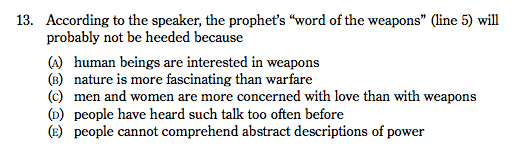
Reading Comprehension

These are questions that test your ability to understand what the passage is saying on a pretty basic level. They don’t require you to do a lot of interpretation—you just need to know what is actually going on. You can identify these from words and phrases like “according to,” “asserting,” “mentioned,” and so on. Basically, words that point to a fairly concrete register of meaning. You can succeed on these questions by careful reading of the text. You may have to go back and re-read parts to make sure you understand what the passage is saying.
Example:
1Comprehension.png 

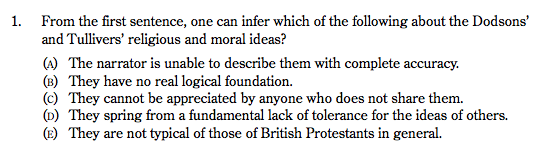
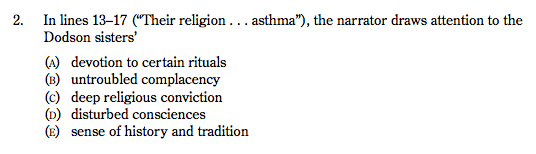
Inference

These questions ask you to infer something—a character or narrator’s opinion, an author’s intention, and so forth—based on what is said in the passage. It will be something that isn’t stated directly or concretely, but that you can assume based on what is stated clearly in the passage. You can identify these questions from words like “infer,” and “imply.”  
The key to these questions is to not be tripped up by the fact that you are making an inference—there will be a best answer, and it will be the choice that is best supported by what is actually found in the passage. In many ways, inference questions are like second-level reading comprehension questions—you need to know not just what a passage says, but what it means.
Example:
2inference.png

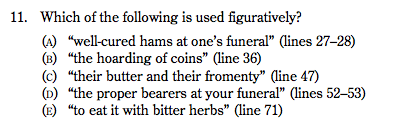
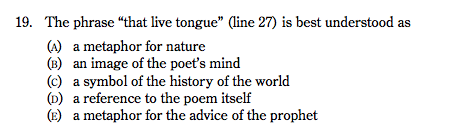
Identifying and Interpreting Figurative Language

These are questions in which you have to either identify what word or phrase is figurative language or provide the meaning of a figurative phrase. You can identify these as they will either explicitly mention figurative language (or a figurative device like simile or metaphor) or will include a figurative language phrase in the question itself. The meaning of figurative language phrases can normally be determined by the phrase’s context in the passage—what is said around it? What is the phrase referring to?
Example 1: Identifying
3Identifying_Figurative_Language.png
Example 2: Interpreting
4Interpret_figurative_language.png

Literary Technique

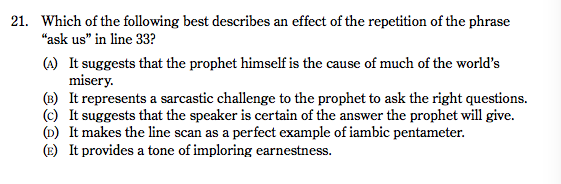
These questions involve identifying why an author does what they do: from using a particular phrase to repeating certain words. Basically, what techniques is the author using to construct the passage/poem and to what effect? You can identify these questions by words like “serves chiefly to,” “effect,” “evoke,” and “in order to.” A good way to approach these questions is to ask yourself, so what? Why did the author use these particular words or this particular structure?
Example:
5literary_technique.png 
Character Analysis
These questions will ask you to describe something about a character. You can spot them because they will refer directly to characters’ attitudes, opinions, beliefs, or relationships with other characters. This is, in many ways, a special kind of inference question since you are inferring the broader personality of the character based on the evidence in a passage. Also, these crop up much more commonly for prose passages than poetry ones.
Example:
 6character_analysis.png 

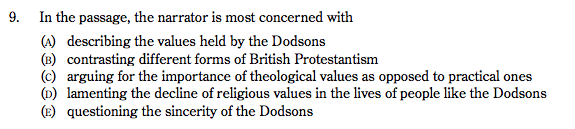
Overall Passage Questions

Some questions will ask you to identify or describe something about the passage/poem as a whole: its purpose, tone, genre, etc. You can identify these by phrases like “in the passage,” and “as a whole.” To answer these questions, you need to think about the excerpt with a bird’s-eye view. What is the overall picture created by all the tiny details?
Example:
7Overall_Passage.png 

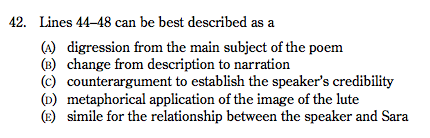
Structure

Some questions will ask you about specific structural elements of the passage—a shift in tone, a digression, the specific form of a poem, etc. Often these questions will specify a part of the passage/poem and ask you to identify what that part is accomplishing. Being able to identify and understand the significance of any shifts—structural, tonal, in genre, etc—will be of key importance for these questions.
Example:
7.1Structure.png
 Grammar/Nuts & Bolts
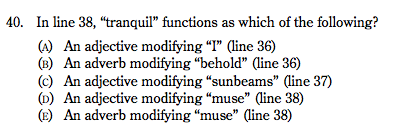
Very occasionally you will be asked a specific grammar question, such as what word an adjective is modifying. I would also include in this category very specific questions like the meter of a poem (i.e. iambic pentameter). These questions are less about the literary artistry and more about the fairly dry technique involved in having a fluent command of the English language.
Example:
8Nuts_and_Bolts.png
That covers the 8 question types!

2019-2020 School Year Overview By-Grade for Classroom 2403 (Mr. Allen)

All of us are looking forward to having he greatest Academic Year at Humboldt High School.  Here are the teachers that will be in c...