If you're planning to take the AP English Literature and Composition exam, you'll need to get familiar with what to expect from the test. Whether the 2020 test date is near or far, I’m here to help you get serious about preparing for the exam. In this guide I’ll go over the test's format and question types, how it's graded, best practices for preparation, and test day tips. You’ll be on your way to AP English Lit success in no time! Mr. Allen.
AP English Literature: Exam Format and Question Types
The AP Literature Exam is a three-hour exam that contains two sections. First is an hour-long, 55-question multiple choice section, and then a two hour, three question free-response section. The exam tests your ability to analyze works and excerpts of literature and also cogently communicate that analysis in essay form. Read on for a breakdown of the two different sections and their question types.
Multiple Choice Section
The multiple-choice section, or Section I of the exam, is 60 minutes long and has 55 questions. You can expect to see 4-5 excerpts of prose and poetry. You will, in general, not be given an author, date, or title for these works, although occasionally the title of a poem is given. Unusual words are also sometimes defined for you.
The date ranges of works could fall from the 16th to the 21st century. Most works will be originally written in English, although you may occasionally see a passage in translation.
There are, generally speaking, eight kinds of questions you can expect to see on the AP English Literature and Composition test. I’ll break each of them down here and give you tips on how to identify and approach them.
The 8 Multiple-Choice Question Types on the AP Literature Exam
Without further ado, here are the eight question types you can expect to see on the AP lit exam. All questions are taken from the sample questions on the “
AP Course and Exam Description.”
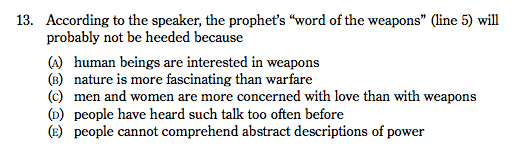
Reading Comprehension
These are questions that test your ability to understand what the passage is saying on a pretty basic level. They don’t require you to do a lot of interpretation—you just need to know what is actually going on. You can identify these from words and phrases like “according to,” “asserting,” “mentioned,” and so on. Basically, words that point to a fairly concrete register of meaning. You can succeed on these questions by careful reading of the text. You may have to go back and re-read parts to make sure you understand what the passage is saying.
Example:
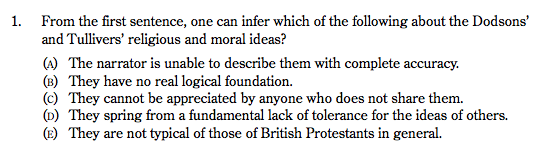
Inference
These questions ask you to infer something—a character or narrator’s opinion, an author’s intention, and so forth—based on what is said in the passage. It will be something that isn’t stated directly or concretely, but that you can assume based on what is stated clearly in the passage. You can identify these questions from words like “infer,” and “imply.”
The key to these questions is to not be tripped up by the fact that you are making an inference—there will be a best answer, and it will be the choice that is best supported by what is actually found in the passage. In many ways, inference questions are like second-level reading comprehension questions—you need to know not just what a passage says, but what it means.
Example:
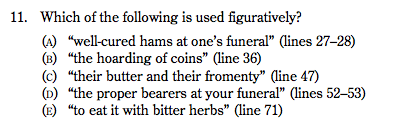
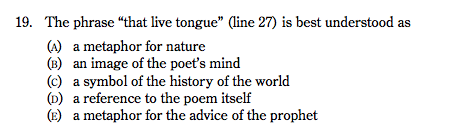
Identifying and Interpreting Figurative Language
These are questions in which you have to either identify what word or phrase is figurative language or provide the meaning of a figurative phrase. You can identify these as they will either explicitly mention figurative language (or a figurative device like simile or metaphor) or will include a figurative language phrase in the question itself. The meaning of figurative language phrases can normally be determined by the phrase’s context in the passage—what is said around it? What is the phrase referring to?
Example 1: Identifying
Example 2: Interpreting
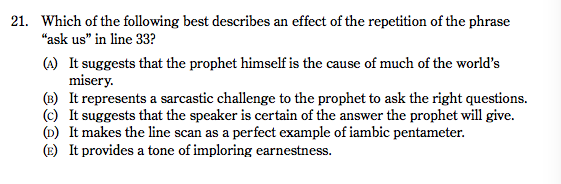
Literary Technique
These questions involve identifying why an author does what they do: from using a particular phrase to repeating certain words. Basically, what techniques is the author using to construct the passage/poem and to what effect? You can identify these questions by words like “serves chiefly to,” “effect,” “evoke,” and “in order to.” A good way to approach these questions is to ask yourself, so what? Why did the author use these particular words or this particular structure?
Example:
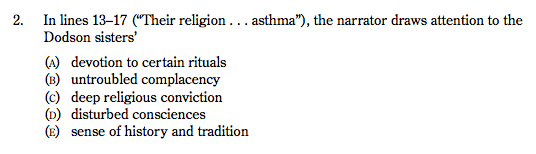
Character Analysis
These questions will ask you to describe something about a character. You can spot them because they will refer directly to characters’ attitudes, opinions, beliefs, or relationships with other characters. This is, in many ways, a special kind of inference question since you are inferring the broader personality of the character based on the evidence in a passage. Also, these crop up much more commonly for prose passages than poetry ones.
Example:
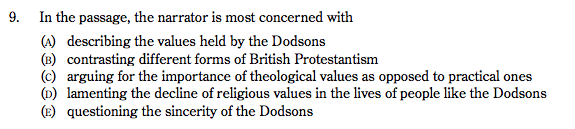
Overall Passage Questions
Some questions will ask you to identify or describe something about the passage/poem as a whole: its purpose, tone, genre, etc. You can identify these by phrases like “in the passage,” and “as a whole.” To answer these questions, you need to think about the excerpt with a bird’s-eye view. What is the overall picture created by all the tiny details?
Example:
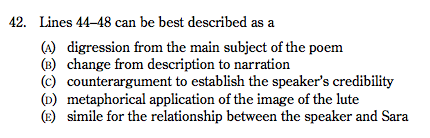
Structure
Some questions will ask you about specific structural elements of the passage—a shift in tone, a digression, the specific form of a poem, etc. Often these questions will specify a part of the passage/poem and ask you to identify what that part is accomplishing. Being able to identify and understand the significance of any shifts—structural, tonal, in genre, etc—will be of key importance for these questions.
Example:
Grammar/Nuts & Bolts
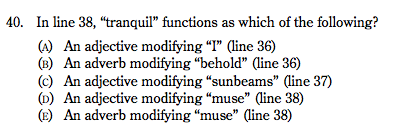
Very occasionally you will be asked a specific grammar question, such as what word an adjective is modifying. I would also include in this category very specific questions like the meter of a poem (i.e. iambic pentameter). These questions are less about the literary artistry and more about the fairly dry technique involved in having a fluent command of the English language.
Example:
That covers the 8 question types!